Humanly Possible: 700 years of humanist freethinking, inquiry, and hope

Perhaps you think of yourself as a humanist; perhaps you do not – but if you are reading this, the chances are you do have some affinity with humanism. You may be drawn to literature and the humanities. You may prefer to base your moral choices on fellow-feeling and responsibility to others, rather than on religious commandments. Or you may simply believe that individual lives are more important than grand political visions or dogmas.
If any of these apply, you are part of a long tradition of humanist living, and you share that tradition with many extraordinary individuals throughout history who have put rational inquiry, cultural richness, freedom of thought and a sense of hope at the heart of their lives.
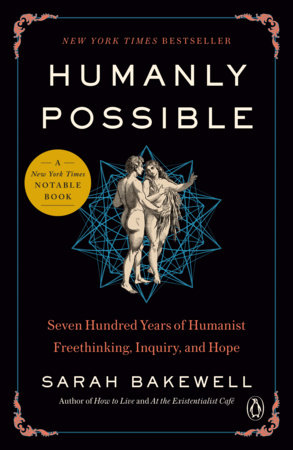
Humanly Possible introduces us to some of these people, as it asks what humanism is and why it has flourished for so long, despite opposition from fanatics, mystics and tyrants. It is a book brimming with ideas, personalities and experiments in living ‒ from the literary enthusiasts of the fourteenth century to the secular campaigners of our own time, from Erasmus to Esperanto, from anatomists to agnostics, from Christine de Pizan to Bertrand Russell, and from Voltaire to Zora Neale Hurston. It takes us on an irresistible journey, and joyfully celebrates open-mindedness, optimism, freedom and the power of the here and now ‒ humanist values which have helped steer us through dark times in the past, and which are just as urgently needed in our world today.
UK: Vintage (paperback), March 2024. Chatto & Windus (hardback), March 2023.
US: Penguin (paperback), March 2024. Penguin (hardback), March 2023.
Canada: Knopf (paperback), March 2024. Knopf (hardback), March 2023.
Translations
Translations are available in:
Czech: Humanismus (Host, 2025)
Dutch: De humanisten (Ten Have, 2023)
French: Qu’est-ce qu’être humaniste? (Albin Michel, 2026)
German: Wie man Mensch wird (C.H. Beck, 2023)
Italian: Umanamente possibile (Rizzoli, 2023)
Portuguese (Brazil): Humanamente possível (Companhia das Letras, 2024).
Spanish: Provocadores y paganos (Ariel, 2024).
Slovenian: Moč humanizma (UMCo, 2024).
Swedish: Humanisterna (Albert Bonniers, 2025).
Turkish: Hümanistler: Özgür Düşünme, Sorgulama ve Umudun 700 Yıllık Tarihi (Domingo, 2024).
Other translations are forthcoming or already available in Chinese, Korean, Russian, Serbian and Ukrainian.
More information will be posted here when available.
To enquire about further translation rights, please contact foreignrights@rcwlitagency.com.
Reviewers say …
“Lively … filled with her characteristic wit and clarity … Bakewell puts her entire self into this book, linking philosophical reflections with vibrant anecdotes. She delights in the paradoxical and the particular, reminding us that every human being contains multitudes.” (Jennifer Szalai, The New York Times).
“A book of big and bold ideas, Humanly Possible is humane in approach and, more important, readable and worth reading, whether you agree with it or not. … Bakewell is wide-ranging, witty and compassionate.” (Dominic Green, The Wall Street Journal).
“Like Bakewell’s previous two books, Humanly Possible skillfully combines philosophy, history and biography. She is scholarly and accessible, and portrays people and ideas with vitality and without anachronism, making them affecting and alive.” (Jane O’Grady, The Guardian).
“Superbly readable, witty and attractive.” (Rowan Williams, New Statesman).
“She works hard so that the reader does not have to … [and] carefully selects only the most interesting and revealing details of her subjects’ lives and works. … Bakewell exemplifies the thirst for life and learning of humanism at its best.” (Julian Baggini, Literary Review).
“An epic, spine-tingling, seamless account.” (Simon Ings, Daily Telegraph).
Read or listen to more by me on humanism …
A few of my favourites:
Humanists UK interview, February 2023.
Penguin Podcast , April 2023.
Travels Through Time podcast, April 2023.
Sean Carroll’s Mindscape podcast, April 2023.
Finally:
I love this profile piece by Jennifer Schuessler, in The New York Times, 3 April 2023 (paywall).
 Sarah Bakewell