
So this is me for the next two months! Very excited to be here.
 If you are in New York next week, and feel so inclined, do join me at the Live from the NYPL series on Easter Monday, April 6, at 7 pm. I’ll be talking with Rebecca Mead, New Yorker writer and author of the fascinating My Life in Middlemarch. It should be a great evening – at least I’m planning to enjoy myself! See more information and book tickets here, at the NYPL site.
Here’s a link to the latest issue of the journal Republics of Letters, featuring a forum on the essay genre. As well as fascinating contributions by other writers on a range of essayists, there’s one by me, “Reverie and Ambush: on the influence of Montaigne.” It’s about Montaigne and one of my favourite French writers, Francis Ponge. 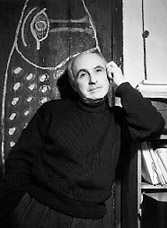
If you don’t know Ponge’s extraordinary, precise prose poems about things – oysters, cigarette ash, pebbles, snails, candles, soap – I’d recommend seeking out his Le Parti pris des choses (Siding With Things). Try this: a bilingual French/English version of his “L’Orange” (“The Orange“). It will have you peering very closely at the pips next time you squeeze your morning OJ.
 To get into the Halloween spirit, and also to indulge myself with of one of my past medical history enthusiasms , I’m giving a talk at Bart’s Pathology Museum in London on the spine-tingling theme of The Reanimators: Galvinism, Frankenstein, and the Spark of Being. It’s on Wednesday 22 October 2014, and tickets are available via the link, though I’m told it’s selling out fast. Do come along and be prepared to shiver your timbers – then cool your nerves with a nice glass of wine afterwards.
Marvellously, How to Live is Andrew Sullivan’s July 2014 book club choice for The Dish – here is his post!

A reader asks:
What are you picking for Book Club #3? I’m super antsy … and July is here. Tell! Tell us! Tell us all! Or just respond so I may quietly read while everyone else is blowing shit up over the weekend.
Heh. Well, yes, it is July, and a major political book did not seem like the best way for me to read on the beach this summer. So I picked a book I’ve long wanted to read but never got around to – about an author who remains among my favorite non-fiction masters of all time and bloggeravant la lettre: Montaigne.
The book is How to Live: Or A Life of Montaigne in One Question and Twenty Attempts at an Answer, by Sarah Bakewell.
It’s an innovative approach to biography – it’s really a series of meditations, based on Montaigne’s life and work, on some…
View original post 444 more words
Kako živeti? Življenje Michela de Montaigna z enim vprašanjem in dvajsetimi poskusi odgovora
December 22, 2013
sarahbakewell
 More great news – the Slovenian edition of How to Live is now available. It was published in November 2013 by Janez Penca.
For Slovenophones, here’s a link to a bookstore, and here’s a link to a long piece about it in Delo. Happy reading! Or, if Google Translate is to be believed, srečna branje!
(Other available translations are listed with links on the How to Live page.)

The Turkish edition of How to Live: a life of Montaigne is now out!
Click on the image or here to follow a link to a Turkish online bookstore where you can, if a turcophone, read more about it.
(Other available translations are listed with links on the How to Live page.)
Thank you very much to Greg Lennes for alerting me to this beautiful photographic blog by Peter Webscott about a visit to Montaigne’s tower. And of course thank you even more to the author/photographer – it’s a really wonderful post, which I wanted to share here.
PLEASE NOTE THAT THIS IS NOT MY OWN POST! Follow the link above to view Peter’s Wordscene site properly – believe me, it’s worth the effort.


How to live? We all have to find our own answer to that question, but part of the enjoyment of the journey is looking at how others deal with it.
The sixteenth century French writer Michel de Montaigne is an interesting case. Withdrawing from public life to his estate near Bordeaux at the age of 38 he decided to dedicate to his life to trying to answer that question through a series of self-soundings which he published as the Essais. A lot of the early essais are quite dry and often repeat what his favourite classical writers had to say. Frequently that was contradictory. But when he starts to explore his own reactions to the world, gaining in self-confidence as he begins to trust his own views over those of the ancients, he becomes much more interesting
He lived in very turbulent times in France during the Wars of Religion, when…
View original post 1,739 more words
A couple of years ago, I wrote a post for Three Guys One Book about a few favourite books in my life, one of which was Dorothy Ann Lovell’s In the Land of the Thinsies .
 A forgotten children’s book with illustrations by Nicolas Bentley, it tells of a girl who neglects to get off at the end of a London Underground escalator, rolls through the crack, and is squeezed flat and shot out into a subterranean world where everything and everyone is as thin as a sheet of pastry.
The copy I read (aged about 8) belonged to my mother, who says she has been nervous of escalators ever since. The impact on me was different. It was the first time I remember having that real science-fiction “sense of wonder”, the tingling effect of encountering a world that is almost familiar, and has a scientific rationale of sorts, yet is utterly bizarre, remote, and dreamlike. It left me with a lifelong fascination for underground worlds, flatlands, hollow earths and the like.
When I wrote about it for Three Guys, I wasn’t able to find any illustrations online, nor a second-hand copy. I could only look at the copy in the British Library, and I found it a bit disappointing, as often happens with remembered marvels.
But I have now just found some images on a brilliant site devoted to illustrated storytelling: Chris Mullen’s The Visual Telling of Stories. Beware: if you go there, you will probably lose yourself for hours.
He gives us a number of double-page spreads from In the Land of the Thinsies, with illustrations and sections of narrative. I hope no one will mind if I post one here. (If anyone does, tell me and I will pull it back through the cracks). Do go to the site to look at more if you are intrigued.
Funny: this time, looking at the images, it does seem marvellous again. How does that work?

 Sarah Bakewell
Comment vivre (dans une poche)
October 26, 2014
sarahbakewell
The French translation of How to Live? has come out in a Livre de poche edition – in fact, looking it up just now in search of a link, I see that it’s their featured title at the moment.
I feel ridiculously excited about it, because I’ve been reading Livre de poche paperbacks ever since I started laboriously struggling through books in French as a teenager. The first one I read, I think, was Jean Cocteau’s Les Enfants terribles, with his own drawing on the cover. I still have that copy, with almost every word underlined in pencil and the English meaning minutely inserted between the lines.
On a purely practical level, I admire them for being good value, beautifully made (they open properly, unlike a lot of UK books), and in small format, so they really do fit into a coat pocket in mid-winter.
On a sentimental level, I admire them for .. well, who needs reasons for being sentimental?
Share this:
2 Comments